Storm-Damaged Tree Removal in Tampa: Hurricane Season Prep Guide (2026)
Atlantic hurricane season starts June 1 and runs through November 30. NOAA's outlook for 2026 calls for an above-normal season, and Tampa Bay sits squarely in the Gulf of Mexico's strike zone. The single most expensive thing a homeowner can ignore between now and June is the trees on the property. This guide walks through what to clear before the first named storm forms, what to do the morning after a tree comes down, how to document it for insurance, and what emergency tree removal actually costs in Tampa Bay.
Quick Hurricane Prep Checklist
- Walk the property and flag dead, leaning, or split trees within striking distance of the house, garage, fence, and utility drops
- Clear branches that overhang the roof or come within 6 ft of the structure
- Trim back any palm fronds touching the roofline (palm fronds become missiles in 60+ mph wind)
- Remove brush piles, loose lumber, and yard debris that becomes airborne in a storm
- Photograph healthy trees from multiple angles - documentation matters if a storm later damages them
- Confirm your homeowner's insurance covers tree removal AFTER a storm (most cap at $500 - $1,000 per tree)
Why Tampa Bay Trees Are a Special Risk
Tampa's tree canopy is dominated by live oak, laurel oak, longleaf pine, slash pine, and cabbage palm. Each one has a different failure mode in a hurricane:
- Live oak: Generally hurricane-resistant if healthy and properly pruned, but the wide horizontal limbs can fail in straight-line winds. Live oaks with included bark or co-dominant trunks split unpredictably.
- Laurel oak: Far weaker than live oak, prone to internal decay, and a leading cause of structural damage in Tampa hurricanes. Laurel oaks over 30 years old are usually a removal candidate, not a trim candidate.
- Slash and longleaf pine: Tall, top-heavy, and shallow-rooted in sandy Tampa Bay soils. The most common species to come down whole in a major storm.
- Cabbage palm: Almost never falls, but loose fronds and dead boots become airborne projectiles.
- Sand pine: Notoriously brittle. If you have sand pines within striking distance of the house, they should come down before hurricane season - period.
Tampa Bay's sandy and shell soils don't anchor large trees as well as the clay soils further north. A tree that looks healthy can have an 8-10 ft root plate that won't hold in saturated ground when a hurricane delivers 8 inches of rain alongside 100+ mph wind.
What to Clear Before June 1
Dead and Dying Trees
Any tree showing the following is a removal priority, not a trim:
- Bark falling off in sheets, exposing bare wood
- More than 25-30% of the canopy dead at the same time
- Mushrooms or conks growing at the base or on the trunk (sign of internal decay)
- Visible cracks in major limbs or the main trunk
- Hollow sound when the trunk is tapped with a hammer
- Lean that's developed or worsened in the last 12 months
- Soil heaving on one side of the root flare (the root plate is failing)
Trees Within Striking Distance
"Striking distance" means the tree's full height plus 10 ft. A 60 ft pine that sits 70 ft from your house is in striking distance. If a tree in striking distance shows any of the warning signs above, the cost-benefit analysis is straightforward: removing one tree before the storm is cheaper than removing four trees, repairing a roof, and waiting six weeks for an insurance adjuster after the storm.
Overhanging Branches
Even if the tree itself is healthy, branches that overhang the roof are the most common storm-damage source in Tampa. Florida's "self-help" doctrine lets you trim a neighbor's tree branches up to your property line at your own expense. Get this done in May or early June before everyone else has the same idea and tree services are booked out three weeks deep.
Yard Debris and Loose Material
A 2-by-4 in 80 mph wind has more kinetic energy than a fastball. Before hurricane season:
- Haul brush piles to the curb on your normal yard waste day - not the day before a storm (collection stops once storm warnings issue)
- Stack lumber inside a garage or shed
- Move loose lawn furniture, garden art, and trash cans into a secure space
- Clean gutters - a clogged gutter overflows and saturates fascia boards already taking wind load
After the Storm: First 48 Hours
If a tree comes down during a hurricane, the first 48 hours determine how much of the cost insurance covers. Do the following in order:
1. Safety First
If the tree is on a power line, on the house, or has pulled the service drop loose, do not approach it. Call 911 if there's a fire or imminent collapse risk; call TECO at (877) 588-1010 for any downed power line. Wait for utility crews to de-energize before any tree work begins.
2. Photograph Everything Before You Touch It
Insurance adjusters need photographic evidence of the damage as it happened. Before any debris is moved, take 20-30 photos covering:
- Wide shots showing the tree's relationship to the structure
- Close-ups of any structural damage (roof, siding, windows, fence)
- The base of the tree (to show whether it uprooted or snapped - matters for the claim)
- Time-stamped photos of you next to the damage for scale
- Any interior water intrusion in the first 24 hours
3. Mitigate Further Damage
Florida policies require the homeowner to "mitigate further loss." That means tarping a damaged roof, boarding broken windows, and getting trees off the structure to prevent additional water damage. Save every receipt - insurance reimburses reasonable mitigation costs separately from the main claim.
4. Call Your Insurance Carrier Before Hiring Anyone
File the claim with your insurance carrier before signing any contract for tree removal or repair. Many Florida policies require that the carrier select or approve the contractor. Signing an "Assignment of Benefits" with a storm-chaser tree service before talking to your carrier can void portions of your coverage.
Avoid Storm Chasers
After every Tampa Bay hurricane, out-of-state crews flood the area selling overpriced and uninsured tree work door to door. Verify any contractor's license at myfloridalicense.com and require proof of general liability + workers' comp before any work begins. A signed contract for $8,000 in tree removal from an unlicensed crew is not just a bad deal - it's also a liability landmine if a worker is hurt on your property.
Insurance: What's Actually Covered
Florida homeowner's insurance treats tree removal in three different ways depending on what happened:
| Scenario | Typical Coverage | Notes |
|---|---|---|
| Tree on house, garage, or fence | Covered | Removal cost capped at $500 - $1,000 per tree on most policies; structural damage covered separately |
| Tree blocking driveway only | Sometimes covered | Some policies cover removal if access to the home is blocked; many don't |
| Tree fell on yard, no structural damage | Usually NOT covered | Homeowner pays out of pocket |
| Neighbor's tree on your property | Your policy | Florida law treats it as your problem to remove unless the neighbor knew the tree was hazardous |
| Stump grinding | Rarely covered | Most policies pay to remove the trunk and large limbs but not the stump |
Read your policy's "Other Structures" and "Debris Removal" sections before hurricane season. The dollar caps are easier to absorb mentally in May than to discover in October.
Tampa Bay Emergency Tree Removal Pricing (2026)
Pricing changes dramatically the moment a storm makes landfall. These are non-emergency baseline prices for Tampa Bay; expect 1.5x to 3x premiums for true emergency response in the 72 hours after a hurricane.
2026 Tampa Bay Tree Removal Price Ranges
- Small tree removal (under 30 ft): $300 - $700
- Medium tree removal (30-60 ft): $700 - $1,800
- Large tree removal (60-90 ft): $1,500 - $3,500
- Very large oak / pine (90 ft+): $3,500 - $7,500
- Tree on structure (crane required): $2,500 - $9,000
- Stump grinding (per stump): $150 - $450
- Emergency call-out fee (storm conditions): +$300 - $800
- Lot-clearing of multiple downed trees: $3,000 - $15,000+
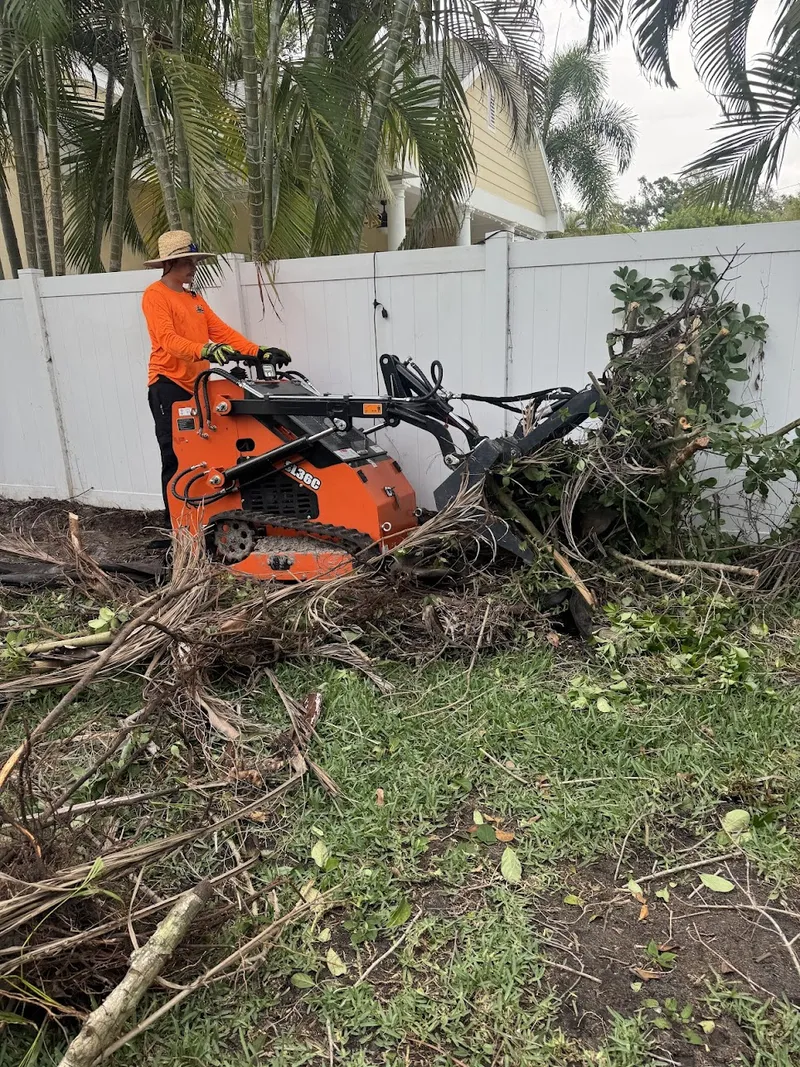
If a hurricane drops three or four trees on your lot at once, calling a tree-removal-only crew can cost more than calling a land clearing contractor with a skid steer and a grapple. For multiple downed trees on a residential lot, a full lot-clearing pass usually beats per-tree pricing.
Pre-Season Pruning vs. Post-Storm Removal
The math on pre-season tree work almost always favors getting it done early:
- Removing one risky 60 ft pine in May: ~$1,500 with no insurance involvement
- Same pine falling on the house in August: ~$3,000 to remove, $8,000 - $40,000 in roof and interior damage, 4-12 weeks displacement, deductible owed regardless
- Pre-season trim of overhanging branches: $400 - $900
- Same branches puncturing the roof: $2,000 deductible plus insurance hassle
Homeowners who routinely come through hurricane season unscathed have one habit in common: they pay for one professional pruning and one professional risk inspection every spring. The total is usually $300 - $1,500. Compared to a single avoided claim, that's the cheapest insurance available.
When Tampa Land Prep Helps
Tampa Land Prep covers the heavy-equipment side of storm work - dropping risky trees before the season starts, clearing multiple downed trees from a lot after a storm, hauling debris piles, and grading the disturbed ground left behind by uprooted root plates. For routine arborist work like canopy thinning, structural pruning, and individual tree health assessments, we'll refer you to a Tampa Bay certified arborist; the line between "tree work" and "land clearing" is real, and using the right contractor for each saves you money.
Get Trees Cleared Before Hurricane Season
Tell us what's on the property. We'll walk the lot, flag the priorities, and quote pre-season removal in writing. After-storm cleanup quotes prioritised during named storm activity.
Get Your Free EstimateRelated Reading
- Rainy Season Land Clearing in Florida - what changes once afternoon thunderstorms become daily
- 5 Signs Your Property Needs Brush Removal
- Land Clearing Cost in Tampa (2026 Price Guide)
- Brush Removal Service
- Land Clearing Service